



High‑performance Linear Variable Beamsplitters built on decades of optical innovation, enabling you to create a fully tunable epi‑fluorescence system with unmatched flexibility.
Linear Variable Beamsplitters
Linear Variable Beamsplitters – also called LV Dichroics – allow you to build fully tunable epi‑fluorescence systems with far fewer components. These continuously variable beamsplitters are typically long‑wave‑pass designs optimized for 45 degrees Angles of Incidence (AOI). By translating the filter along its length, you can select the exact cutoff wavelength needed for your excitation and emission separation.
We offer two core types of variable beamsplitters. LV Dichroics provide a nearly linear shift of the edge along the substrate, while EV Dichroics offer an exponential edge shift. Both types integrate seamlessly with our Linear Variable Bandpass Filters and Linear Variable Edge Filters to form a complete, fully tunable epi‑fluorescence filter set.
Benefits of Linear Variable Beamsplitters:
- Enable completely tunable epi‑fluorescence setups using a single beamsplitter
- Replace multiple fixed dichroics with one compact, continuously variable component
- Fast, wavelength selection by translation
- Smaller and simpler systems compared to filter wheels
- High transmission and stable optical performance

How does an LV Dichroic work?
Continuously Variable Dichroics – also known as Linear Variable Dichroics – are essentially linear‑variable edge filters optimized for a 45‑degree angle of incidence.
Wavelengths shorter than the edge are reflected, while wavelengths longer than the edge are transmitted.
As the filter is translated through the beam, the cutoff position shifts accordingly, changing the division between reflected and transmitted wavelengths.
The spectral variation is often close to linear with respect to position, but it can also follow other functional profiles, such as exponential.
Continuously Variable Dichroic product specifications
Below you can explore a selection of products we have manufactured. Some are available from stock, while others are made to order.
We work closely with our customers to design customized filters tailored to the specific needs of each application.
| Name | Edge/center (nm) | Transmission | Product number | Max size | Data sheet |
|---|---|---|---|---|---|
| EV Dichroic | 360 - 860 | T > 90% | LF104556 | 110mm x 17mm x 2mm |  |
| LV Dichroic | 320 - 760 | T > 90% | LF102227 | 60 mm x 23 mm x 1 mm | |
Product example: LV Dichroic (LF102227)
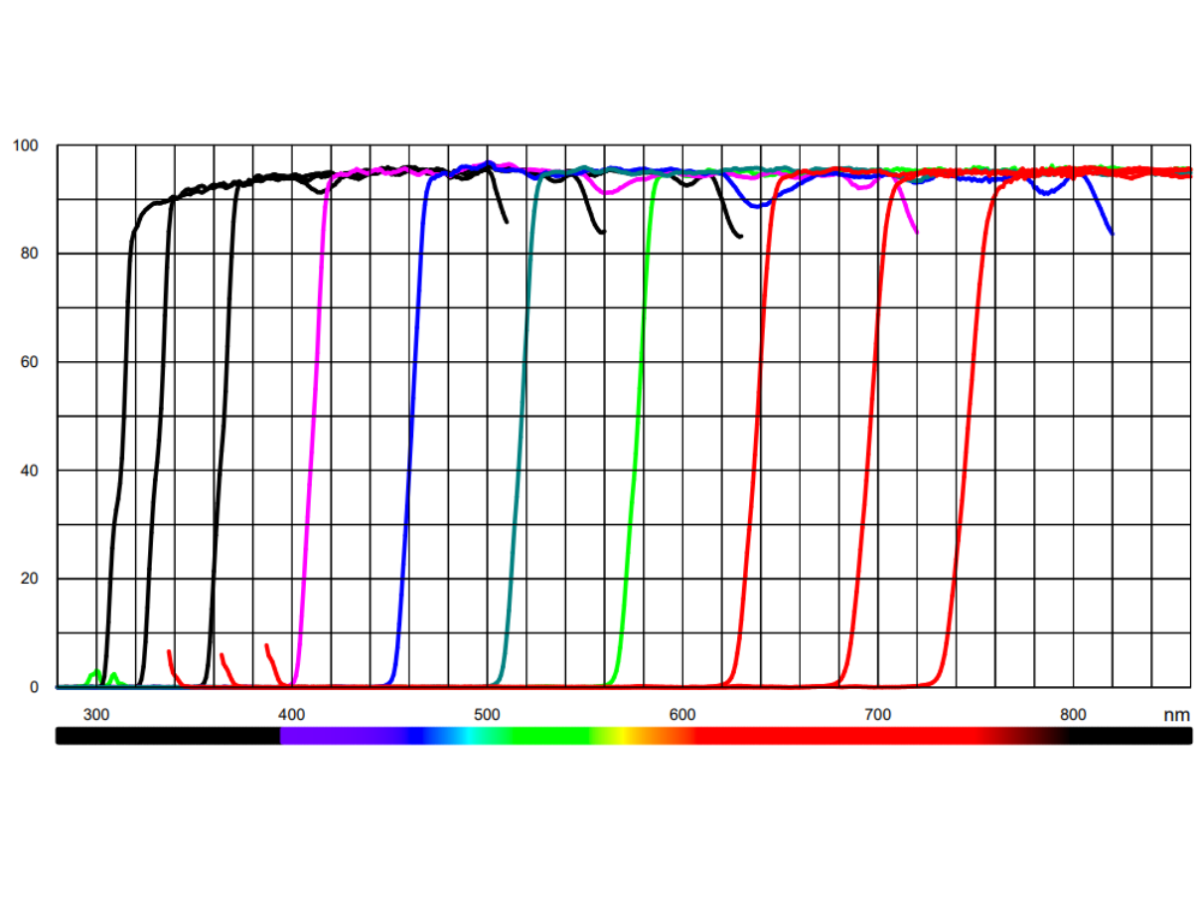
This filter is a Continuously Variable Long Wave Pass filter with a nominal Angle of Incidence (AOI) of 45o that can be used as a beam splitter
- The 50 % edge wavelength travels from ≤ 320 nm to ≥ 760 nm within ≤ 58 mm
- Broadband transmittance is ≥ 81 % for λ50% in the 320-420 nm range and ≥ 87 % in the 420-760 nm range
- Averagne broad-band blocking is ≤0.05% for λ50% in the 320-420 nm range and ≤0.1% in the 420-760 nm range
Typical applications of Linear Variable Dichroics

Tunable EPI fluorescence
A linear variable dichroic can be paired with a linear variable excitation filter and a linear variable emission filter to create a fully tunable epi‑fluorescence system. The excitation LV filter selects the illumination wavelength, the LV dichroic provides a position‑dependent beamsplitter that matches the chosen band, and the LV emission filter isolates the corresponding fluorescence band. By translating all three elements in synchrony, the system becomes continuously tunable across a broad spectral range without changing optics.
Learn more about optical filters for fluorescence in this technical note.
Frequently asked questions about Linear Variable Dichroics
What advantages does a linear variable dichroic offer compared to fixed‑wavelength dichroics?
It provides continuous tunability, replaces multiple fixed dichroics, and enables compact, flexible optical designs.
Does the variation of the edge wavelength have to be linear?
No. The gradient is often close to linear, but it can follow other functions if required.
Can linear variable dichroics be customized to specific wavelength ranges and system geometries?
Yes. They can be tailored for custom spectral ranges, gradients, sizes, and angles of incidence.
What applications benefit most from linear variable dichroics?
The main application of linear variable dichroics is tunable fluorescence systems.
Get in touch
Have a look at our existing products or get in touch regarding your needs – we are the optical filter company.