



High‑performance Linear Variable filters built on decades of optical innovation, enabling you to reduce system complexity.
Linear Variable Filters
Continuously Variable Filters (CVFs) – also known as Linear Variable Filters – from Delta Optical Thin Film offer unprecedented tunability over a large wavelength range, steep filter edges and high out of band blocking. These filters have enabled many applications that was previously not possible.
A CVF is a wedged filter, whose spectral properties vary continuously along one dimension of the filter. It is common to call these filters Linear Variable Filters (LVFs) but, we do however prefer to call our filters Continuously Variable Filters because the progression along the long side of the filter is never 100% linear and can sometimes be for example exponential.
A single CVF for example can replace a large number of fixed filters or a grating based monochromator in an instrument. It is possible to adjust the center or edge wavelength by sliding the filter or rotating it and in this way build a tunable wavelength filter and/or an adjustable bandpass filter.
Our Continuously Variable Filters come with various functionality:
• Continuously Variable Bandpass Filters (CVBP)
• Continuously Variable Long Wave Pass Filters (CVLWP)
• Continuously Variable Short Wave Pass Filters (CVSWP)
• Continuously Variable Dichroic Beamsplitters (CVBS)
• Continuously Variable Order Sorting Filters (CVOSF)
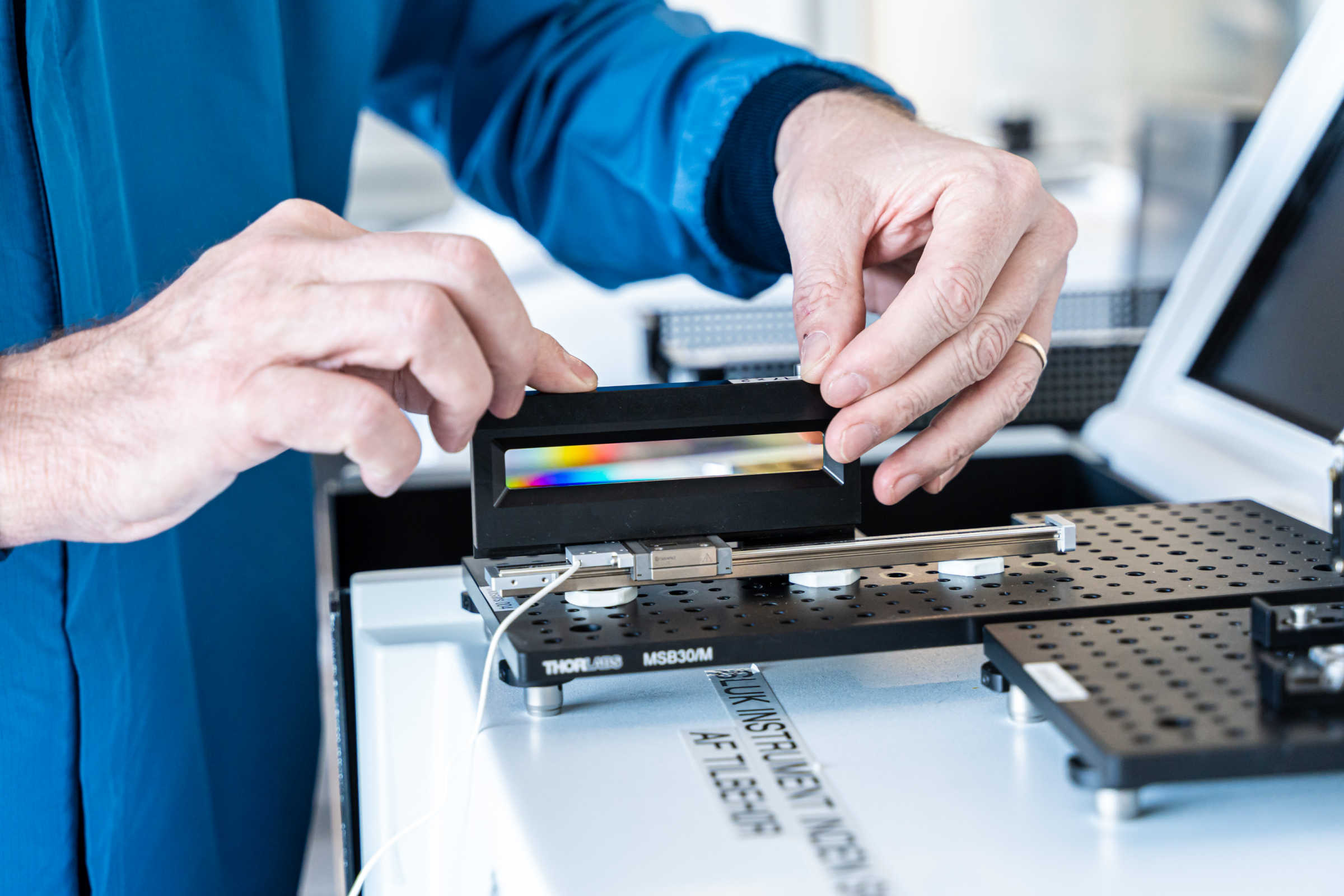
Watch the video
Tune your own Bandpass Filter
This video show the benefit of combining a CVLWP with a CVLSP to form a Bandpass Filter where both center wavelength and bandwidth is tunable.
Product categories
We have divided our CVF’s into a number of relevant product categories:
Product example: LVSWP (LF104562)
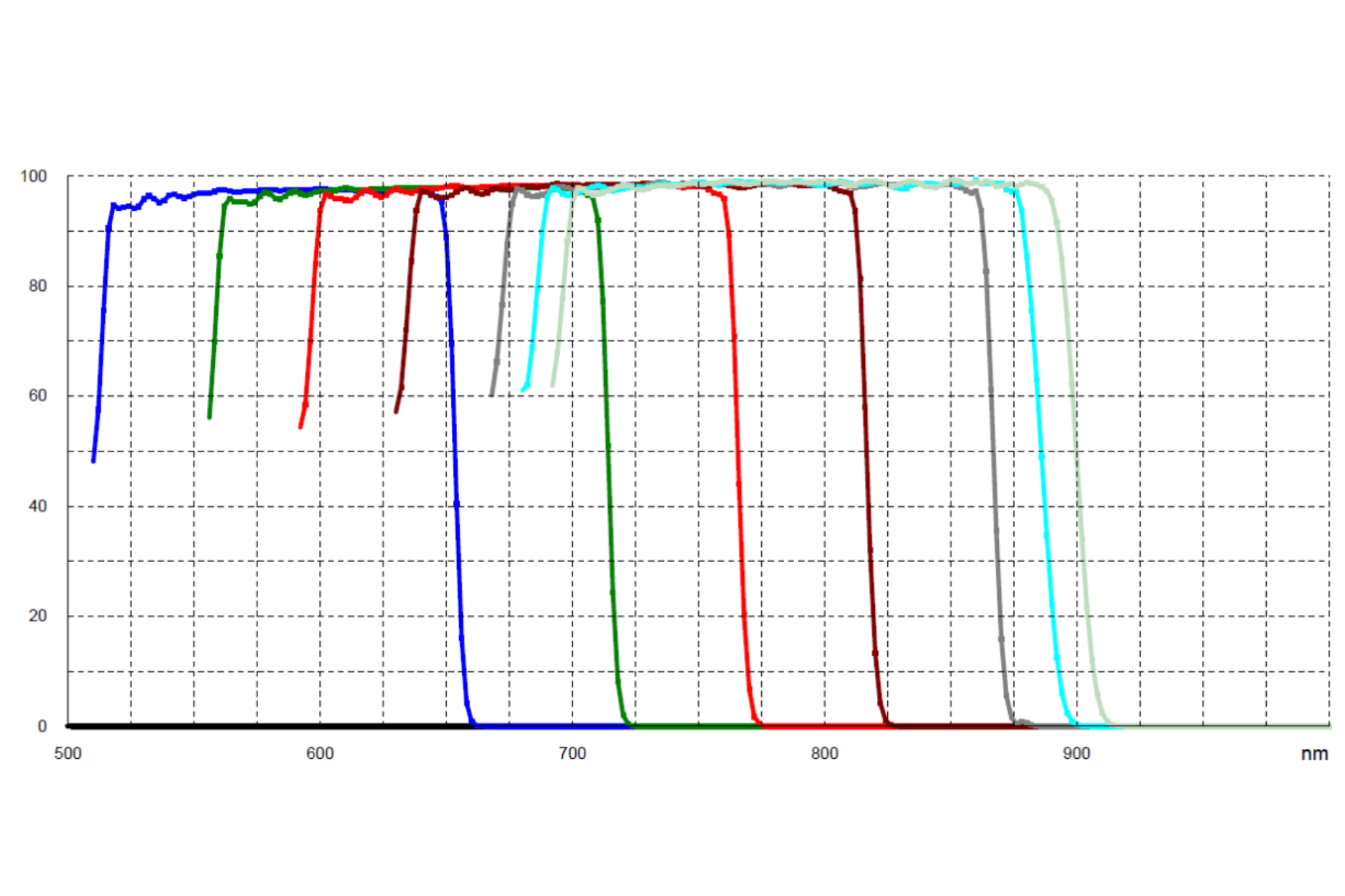
Continuously Variable Short-Wave Pass Filter for the visible-nir wavelength range from 520 nm to 900 within.
- Filter edge monotonously increasing from 652.5 nm to 895 nm within 66.6 mm
- Average passband transmittance larger than 92%
- Average rejection-band blocking of OD4 (> 20 nm from 50% edge wavelength.
Typical applications of Linear Variable Edge filters
Wavelength scanner/mono-chomator
When combined with a broadband light source, a a set of CVSWP and CVLWP filters can be used to create a tunable filter. This allows the selection of center wavelength and bandwidth by translating the filter along the long edge of the substrate.
Read how to create tunable filters using linear variable filters in our tech note here.

EPI-fluorescence
For EPI-Fluorescence applications, our Variable Edge Filters are often combined with a Continuously Variable Dichroic. If an extended blocking range is required, this can be achieved by inserting Homogeneous Blocking Filters in the light path at certain wavelengths. Read more about linear variable filter sets for epi-fluorescence here..

Tunable light source
When combined with a broadband light source, our Linear Variable Bandpass Filters can be used to create a tunable light source. By translating the filter along the long edge of the substrate, you can select any desired wavelength.
Read how to create tunable filters using linear variable filters in our tech note here.
Compact spectrometer
A Linear Variable Bandpass Filter mounted directly above a photodetector array forms a compact and rugged spectrometer assembly without any moving parts.
Linear Variable Filters can also be used as the order sorting filter in a compact grating-based spectrometer. Read more about linear variable filters as order sorting filters here.
Frequently asked questions about Linear Variable Filters
How linear is a Linear Variable Filter?
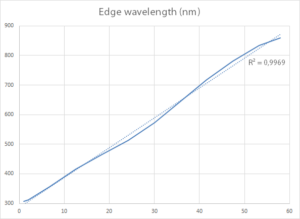
The term Linear Variable Filter seems to imply that the relation between edge or centre wavelength versus position along the filter is linear. However, in reality this is not strictly true.
Delta Optical Thin Film A/S used the term Linear Variable Filter in the beginning because it was coined several decades ago – long before Delta Optical Thin Film A/S began to produce this type of filters. The preferred term however is Continuously Variable Filter.
In reality, the relation is an s-shaped, monotonic function that deviates only slightly from a straight line:
Can a Variable Filter have another function than linear?
Yes, for different purposes it is possible to design the function of edge or centre wavelength versus position along the filter deliberately non-linear, for example exponential, to compensate for angular effects or the change of bandwidth with center wavelength of variable bandpass filters.
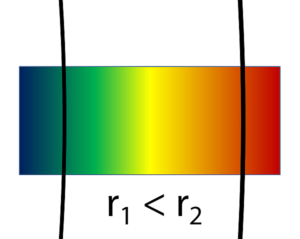
In fact, there is a second type of non-linearity. This concerns the shape of lines of constant edge or center wavelength perpendicular to the wavelength gradient. Due to the production process the lines of constant edge or center wavelength are ring segments. Their curvature radius changes along the filter and is large compared to the filter’s dimensions:
What are the main benefits of Linear Variable Filters?
LVFs provide continuous wavelength tunability, compact system design, and high spectral stability. They often replace large filter sets, simplify instrument architecture, and enable fast, flexible wavelength selection in compact spectrometers, imaging systems, and hyperspectral setups.
What are the main applications of Linear Variable Filters?
LVFs can be used for many different applications - and we and our customers constantly discover new possibilities. Some of the typical applications are:
- Scanning wavelength mono-chromators
- Tunable light sources
- Versatile EPI-fluorescence systems
- Order sorting in grating spectrometers
How do Linear Variable Filters work?
A linear variable filter is an interference filter consisting of many layers of dielectric materials with alternating high and low refractive index. To obtain the linear variability along the edge of the filter the thickness of the layers is wedged such that the stack of dielectric is "thin" in one end and gradually becomes "thicker" towards the other end.
Edinburgh Instruments has written an article that shows the benefit of using Linear Variable Filters in grating-based spectrometers
Get in touch
Have a look at our existing products or get in touch regarding your needs – we are the optical filter company.